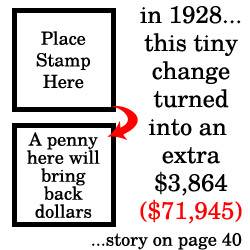
In 1928, someone removed 3 words on an envelope.
Then added 7 new words.
The result?
An extra $3,864 in sales. ($71,945 in today's dollars.)
What changed?
Instead of "Place Stamp Here"...
..."A penny here will bring back dollars."
That's it.
Same envelope. Same location. Different words.
That's human psychology.
Try this...
For any piece of "attention real estate", ask 6 questions:
- What change will reduce friction here?
- What change will add urgency/scarcity here?
- What change will inject social proof here?
- What change will create reciprocity here?
- What change will capture data here?
- What change will offer a benefit here?
For example...
That "View Reviews" link on your product page.
What if you changed it to: "Why 278 people love this"?
That's question #3 above.
Same link. Same destination. Different words.
The concept still works today because human nature doesn't change.
Here's where I found this story...
Last fall, I was doing some consulting with a businessman in California.
In his archives, I stumbled across an interview of a copywriter in Texas who claimed to have the largest private collection of marketing books in the world...
Over 5,000 books.
After describing his favorites, the copywriter was asked: "Any other masters that really aren't well known? Real gems?"
His response?
"Oh, I almost never tell people about this one. This is a real giveaway here, a real million dollar tip."
And then he spilled the beans.
Now, this book is pretty rare today.
(There's a rough scan on eBay for $100, but it's a different edition and missing pages. Some sites that claimed to have it were loaded with malware. I never found a clean copy online.)
I searched for a good copy that wasn't missing pages or marked all up.
And finally found a beautiful copy...in Finland of all places.
I shipped it to a library in Europe and digitized it there.
I do believe it's fair to say this is the best digital copy of the book in the world today.
Now...that stamp strategy from page 40?
It's just one idea from chapter 4: "Jujitsu Your Sales."
Here are three more...
Idea #1: The Hardware Store Window (page 43)
A hardware store owner made one tiny change to his window display.
He turned all the hatchets and hammers around...
The handles extended toward the people passing by.
And sales increased immediately...
Why?
I think because people could see the handles facing them, they imagined picking them up.
Once their imagination could visualize gripping them...
They wandered into the store to see what it felt like in reality.
Try this: Show your product in a way that triggers people to imagine using it.
Don't just show a picture of a coffee cup with a transparent background.
Show it with the handle positioned just how it would be if it had just been set down after taking a sip.
Full of steamy, fresh brewed coffee.
Take the photo from the exact angle of someone sitting, getting ready to reach out and pick it up.
Now it's easier to imagine taking a sip.
Idea #2: The "25 Customers" Test
(page 44)
Mr. Haldeman-Julius sold 100,000,000 books.
(That's not a typo. 100 million.)
Here's how he says he pretested them:
He'd make a list of 25 imaginary readers.
He'd think about each one being offered the book.
If 15 out of 25 would buy in his imagination, he had a winner.
Try this: Write down 25 different customer avatars.
Run through each one: "Would Tom, the solopreneur, buy this?
If 15 of 25 would buy (in your head), run the offer.
Idea #3: The Jiu-Jitsu Salesman
(Page 46)
There's a salesman in the book who uses a Japanese Jiu-jitsu trick...
He throws a man with his own forces.
His opening line?
"I'm not much of a salesman. I used to be a buyer for the So-and-So company. And I can't help looking at things from the buyer's point of view."
He didn't sell...
He helped customers buy.
Instead of: "Buy my course on email marketing!"
Try this: "I used to waste $10K/month on email campaigns that didn't convert. Here's what I learned..."
That will remove resistance.
And there's lots more...
More inside the book...
There are 221 pages in the book.
So many insights on human nature.
Strategies that will work even better today.
Click here to get the book...
This one's a real gem...
See you on the inside,
Jack Duncan
P.S. - Here's what really surprised me...
This book was published 8 weeks before Black Thursday in October 1929.
All throughout the book, the author keeps warning: "There is an emergency."
Chapter 15 lays out exactly what President Herbert Hoover needed to do to avoid The Great Depression.
Of course, the advice came too late.
Here's the weird part: 1929 compared to 2025.
Back then: Jobs being lost to machines. Machines cranking out too much. Selling costs killing profit. etc...
Sound familiar?
The author dedicates the last pages of his book to laying out the 7 steps a business owner should take to avoid The Great Depression from destroying their business.
It's a unique first-person analysis from someone who was there.
Right in the thick of it.
And he not only saw it coming, he published his solution.
Those 7 steps are just as valuable in 2025 as they were 8 weeks before Black Thursday, 1929, when this book was published.
They're definitely worthy of your attention in the coming months.
Click here to get the .pdf copy of this book...
