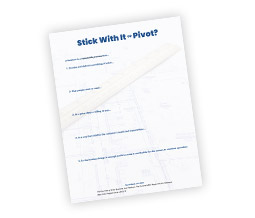
On Wednesday, you completed #5 on the Stick With It or Pivot worksheet, and now you've got a detailed description of what a worthwhile business looks like.
(If you missed that email, it's here.)
Now we'll start on #4 by first answering this question...
Who do you want to serve?
What group of people would you like to spend time with and overdeliver to each day?
In exchange for your extraordinary value (#4 on the worksheet), they will help you create a worthwhile business (#5 on the worksheet).
Overdelivering takes time, energy, and resources. You'll only be able to do this for a hand selected group.
That group is your
Smallest Viable Audience...
Let's focus on the word
"Smallest" for a minute...
In This Is Marketing, Seth Godin explains it this way...
|
"You'll never be able to serve everyone, which is comforting, since you're less likely to be disappointed when it doesn't happen. |
Here's the same idea from nature...
A few years ago, I saw an ant trying to drag a large piece of food.

It got my attention because the food was so much heavier than the ant, and I was curious to see how he would carry it.
As I watched, I noticed that the ant kept going in one large circle, because of how heavy the food was.
I watched for about 10 minutes to see what would happen next.
The ant just kept at it...
He was working extremely hard, but because he was just going in circles, 98% of the time he was going in the wrong direction.
If the ant had just taken a smaller portion, he would have been speeding along to his destination.
The complexity of mass marketing and "trying to be all things to all people" pulls you in every direction.
Like the ant, you can avoid spending 98% of your time going in the wrong direction by choosing a smaller portion that you can actually serve.
Now let's focus on the word
"Audience" for a minute...
Your audience is the group of people you serve every day...
Choose a group to amaze...
|
"Everything gets easier when you walk away from the hubris of everyone. Your work is not for everyone... |
Since you're going to be talking and interacting with your audience all the time, these should be people you like being around.
Start by thinking about the general characteristics of people you already enjoy being around.
You can also use characteristics in people you don't like to be around to give you clues.
Try this quick exercise...
It's called "Like This...Not That" and is a modification of an exercise in
Do More Great Work.
Step 1: Draw a line down the middle of a piece of paper. Write "Like This..." on the left side and "Not That..." on the right side.

Step 2: Write down charactertistics of people you enjoy being around on the left side. Then write the opposite for each one on the right side.
|
John's Example: |
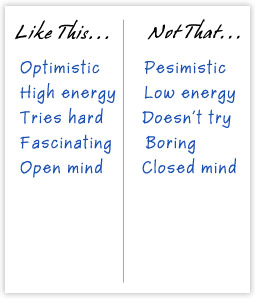
Step 3: Write down any additional characteristics of people that you don't enjoy being around on the right side. Then write the opposite for each one on the left side.
|
John's Example: |
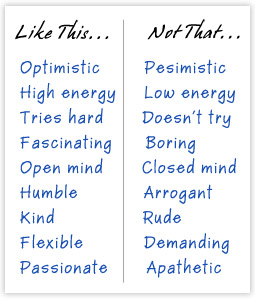
Now that you've got a list of general characteristics of people you like to be around, you can use it to help you make a list of audiences you've served in the past.
Your notes from yesterday can be helpful here as well, as they might contain clues.
|
John's Example: |
Next, you'll need to narrow down to one of these specific audiences.
|
"Delight the few to attract the many. |
As far as exciting goes, don't worry about what other people get excited about...
Answer these two questions:
Which of these audiences gets you the most excited?
And...
Which of these audiences would most appreciate your excellence?
|
John's Example: |
Now it's time to go even smaller.
You're looking for a group within the audience that isn't being served well.
Let's use Seth Godin's exercise
Positioning As A Service...
Step 1: On a piece of paper, draw an X/Y grid.

Step 2: Pick two different attributes that your audience cares about.
For each attribute, pick two words that represent the extremes for that attribute, then put one pair on the X axis and one pair on the Y axis.
|
John's Example: |
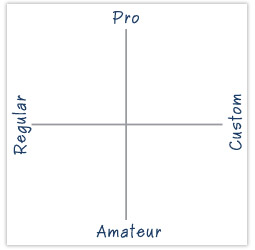
Step 3: Mark the grid to show the specific areas currently being served.
|
John's Example: |

Step 4: Look at the grid and see if there's a small audience that's not being served well.
|
John's Example: |
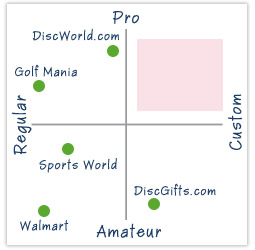
Seth Godin points out that this X/Y grid also makes it very clear why "someone would be correct in their decision not to choose you".
When you choose a particular point on the grid, you can say with confidence: "That audience has different needs that I'm not able to serve right now because I've chosen to overdeliver to this audience."
|
"The most difficult yet important question you make when focusing is deciding what you're not going to be. |
|
"Sales is a disqualification process. The more junk you can eliminate before you spend money and effort, the more effective you are." |
When you get this selective, you can make something really special for your audience.
And when you honestly share with them what you've done, the Unique Selling Proposition (USP) is obvious.
In other words, it's not "just words".
Your product really is unique.

|
"In Cincinnati, there's a fellow who understands focus. His name is Ken Eilers. He's "the screen man." He fixes screens for buildings. He doesn't do doors, windows, or window boxes. Ken and his customized Screen Mobile fix screens. Ken says it's a simple concept: "I don't want to compare myself to a brain surgeon, but if you only do one thing, you tend to get good." Ken is booked months in advance because of his expertise. When you deliver true excellence in one very focused area, it tends to give credibility to all parts of your business." |
What about competitors?...
"Is it ok to pick an audience if there is some competition?"
Competition can be a good thing, because it means that a market exists.
|
"Market matters most; neither a stellar team nor a fantastic product will redeem a bad market. Markets that don't exist don't care how smart you are." |
Let me be clear...
You're not trying to create a new audience that doesn't exist. You're trying to find an existing audience that isn't being served well, so you can "roll out the red carpet".
When you focus all your energy to give them world class service, you become the "only business" they want to work with.
|
"All businesses exist on a continuum between 100% commodity and 100% monopoly. |
Lastly, let's talk about
"Viable" for a second...
At this point, you've found a "small audience", but you don't know if it's "viable" yet.
That's coming next...
Next week, I'll show you a simple way to find out what problems this audience has, so you can know how valuable a solution would be.
And once you know how valuable your solution could be, you'll know if you've found your "smallest viable audience" just by looking at #5 on your worksheet...
Until then,
Jack Duncan
MarketBold.com
