Yesterday, we looked at the 5 parts of every successful business and how to use critical assumptions to determine if you should pivot.
(If you missed that email, it's here.)
On the Stick With It or Pivot worksheet, we worked backwards with #5..."How much money will your business need to create to make it all worthwhile?"
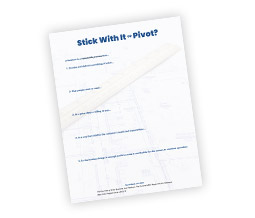
I mentioned yesterday that there was a more important aspect to think about, when trying to determine what would make it all worthwhile.
Some people find this aspect "unrealistic" to consider.
They're life motto could be:
"Life's hard, then you die."
But here's the deal...
Remember the Flickr pivot story?
One of Flickr's founders said this:
|
"So often people are working hard at the wrong thing. Working on the right thing is probably more important than working hard." |
That's true on many levels...
Not just "Should I keep developing Flickr as an online game?"...but also "Do I enjoy what I do everyday?".
Steve Jobs believed this too...

|
"Your work is going to fill a large part of your life, and the only way to be truly satisfied is to do what you believe is great work. And the only way to do great work is to love what you do." |
Money is only a small portion of the "worthwhile" element of a business.
|
"If the only thing that interests you about an opportunity is the money, you'll probably quit well before you find the pot of gold at the bottom of the landfill." |
The next step is to figure out and then write down what you actually enjoy doing right now.
The best part: You get to use all of your colorful experiences to paint a clear picture of what you love.
Along the way, you may confirm that you're still in love with what you do.
That's great news.
Or, you may discover during this process that your business isn't as worthwhile as you once thought.
Maybe you're business has slowly turned into a Frankenstein monster.
And "the money" is all that's left.
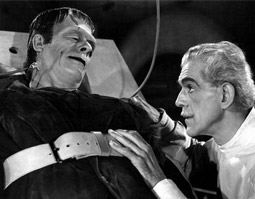
That's great news too.
Because that realization could trigger "the mother of all pivots"...
A life pivot.
|
"You cannot change dramatically until you have fully faced the facts of who you are and where you are going." |
Making it more worthwhile by making it more enjoyable is
a great reason to pivot.
|
"Though no one can go back and make a brand new start, anyone can start from now and make a brand-new ending." |
And it's not hard...
The following short exercises will take you into the Past, Present, and Future.
Along the way, a clear picture of who you are will develop.
This is going to help you see what would make this all worthwhile, beyond the money.
Grab some paper...
Let's start in the Past.
This exercise is called
Peak Moments.
It's was developed by Michael Stanier, founder of Box of Crayons and was featured in the book,
Do More Great Work.
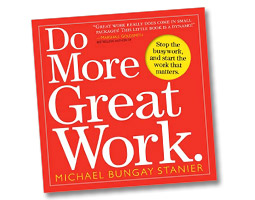
Step 1: On a piece of paper, write down 3 or 4 peak moments from your working life. Think back and write down work that brought out your "best self".
|
John's Example: |
Step 2: For each item, answer these questions: Where did it occur? What skills did you use? Why was this such a key moment? What about this moment makes you really proud?
|
John's Example: |
Step 3: Look through each description for similarities and patterns. Look for patterns in Who, What, When, Where, How, and Why. Write those down.
|
John's Example: |
This exercise reminds you what it felt like when you were at your best, and when that happened.
You'll use these insights you've discovered in just a few minutes...
Let's try another exercise.
This is called The Time Machine.
Step 1: Travel back to when you first started your current business.
Step 2: Write down the answers to these simple questions:
Why did you start this business?
What was your vision back then?
In what ways is it the same now?
In what ways is it different now?
|
John's Example: |
Step 3: Look through your "reason why" and ask "Who am I?".
|
John's Example: |
Between Peak Moments and The Time Machine, you're getting a much better picture of who you are and what you like to do.
Now let's move to the Present.
This first exercise appeared in the book, Values Clarification by Sidney Simon.
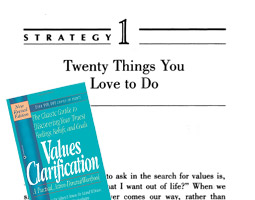
Step 1: Write twenty things you love to do. They can be big or little things and they can happen during any season of the year.
Step 2: After making your list, code each item using the following values:
A. Place a dollar sign ($) next to things that cost money to do.
B. Place an "A" next to things you like to do alone. Place a "P" next to things you like to do with other people. And place "A-P" if you enjoy it just as much alone as with other people.
C. Place "PL" if the thing requires planning ahead.
D. Place an "O" next to things that you like doing outside and an "I" next to things you like doing inside.
E. Place a "W" next to things that are related to your work.
F. Place an "R" next to things that are risky or cause an adrenaline rush.
G. Place an "F" next to things that you like doing fast and an "S" next to things you like doing slow.
H. Place a 1-5 next to the five most important items. The thing you like doing the most would be #1 and second best would be #2, etc.
|
John's Example: |
Step 3: Write down the patterns you see and what it tells you about who you are...
|
John's Example: |
Now let's go to the Future.
This next exercise is adapted from the bestselling book by Barbara Sher, WishCraft.
It's called Ideal Life
Step 1: On a piece of paper, describe what your ideal day would look like. Write as if it was actually happening. You see, feel, and experience everything going on around you.
|
John's Example: |
Step 2: Describe an imaginary environment where you would thrive. Expand on your Ideal Life paragraph by zooming in and answering this question, In what imaginary environment would your best work emerge?
|
John's Example: |
Step 3: Look over both paragraphs. How are things totally different than today? How are things nearly the same as right now?
|
John's Example: |
The last exercise is called
The Fresh-Eyes Challenge.
This is an exercise that Doug Hall uses at Eureka! Ranch and explains in the book, Jump Start Your Business Brain.
Step 1: Imagine for a moment that you're a takeover specialist. You've just bought your business.
Step 2: Write down the answers to these questions:
Whom would you fire? (employees, suppliers, customers)
Whom would you hire?
What areas of the business would you invest in?
What areas of the business would you shut down?
|
John's Example: |
Step 3: Looking over your answers, how does this help you understand yourself better? Write down your thoughts...
|
John's Example: |
Ok, at this point, you've got a lot of insights to work with.
Between Peak Moments, The Time Machine, Twenty Things, Ideal Life, and The Fresh-Eyes Challenge you've got a much better understanding of who you are and what you like.
Thinking about it all, if your business was a perfect fit for you, how would you finish the following statement:
"My business allows me to ___________________________.
And this makes it all worthwhile.
|
John's Example: |
Make sure it feels just right...
It's a good sign if you get excited
just thinking about it.
|
"If you want to get customers excited, you yourself must be genuinely excited!" |
Ok, now for the last step...
Take this new statement and add it to the statement you wrote down yesterday on the Stick With It or Pivot worksheet...
|
John's Example: |
That's much better.
Now it feels just right.
And it's written in a way that you can tell immediately if it's True or False.
Which means that you can use it to pivot in the right direction...
And each pivot will get you closer to a worthwhile business.
A business you love waking up to...
And in the next email, you'll see how this simple statement also helps you find the perfect audience to serve...
Until then,
Jack Duncan
MarketBold.com
